
Properly sizing your gutters and downspouts is crucial for effective water drainage and preventing structural damage. This guide provides detailed steps and considerations to help you determine the right sizes for your home.
Understanding Gutters and Downspouts
Gutters and downspouts are essential for managing rainwater from your roof. They work together to protect your home from water damage and erosion.
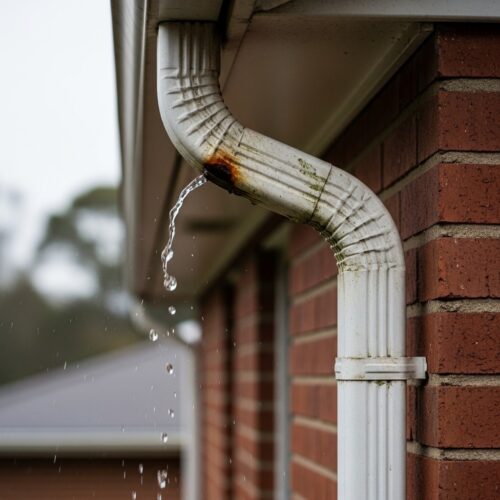
The Role of Gutters in Water Management
Gutters collect rainwater from your roof. They run horizontally along the roof’s edge, channeling water into downspouts. Here’s how they function:
- Collection: Gutters capture rain as it falls.
- Diversion: They channel the water away from your roof and foundation.
- Protection: Properly sized gutters help prevent water damage to walls and foundations.
For example, if your house has a large roof area, you’ll need bigger gutters to handle the increased water flow. Using the wrong size can lead to overflow and expensive repairs.
How Downspouts Affect Drainage Efficiency
Downspouts are the vertical pipes that carry water from the gutters to the ground. Their role is crucial for effective drainage. Here’s what you need to know:
Table of Contents
- Size Matters: Downspouts should match the size of your gutters. For instance, 5-inch K-style gutters typically use 2-by-3-inch or 3-by-4-inch downspouts.
- Quantity Counts: Having enough downspouts helps manage heavy rainfall. For homes with large roofs, a downspout every 30 feet is a good rule of thumb.
- Placement: Position downspouts away from the foundation. This keeps water from pooling around your home.
Inadequate downspout sizing can lead to blockages and overflow, causing water to pool around your foundation—definitely something you want to avoid!
Quick Reference for Sizing
| Gutter Type | Roof Area Capacity | Common Downspout Sizes |
|---|---|---|
| 5-inch K-style | Up to 5,520 sq. ft. | 2×3 inches or 3×4 inches |
| 6-inch K-style | Up to 7,960 sq. ft. | 4×5 inches |
| 5-inch Half-Round | Up to 2,500 sq. ft. | 3-inch diameter |
When sizing your gutters and downspouts, consider your roof area and local rainfall intensity. This will help ensure your system effectively manages water runoff.
Factors to Consider When Sizing Gutters
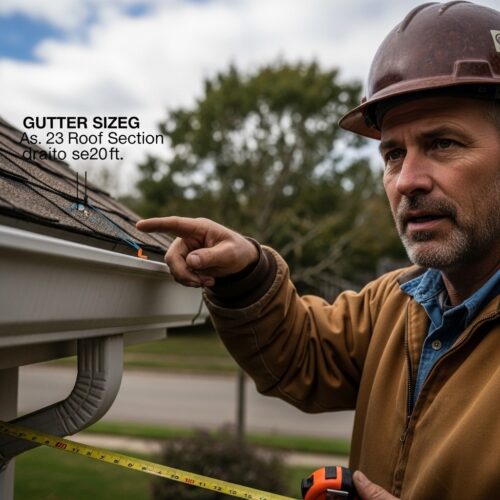
When it comes to sizing gutters and downspouts, several key factors come into play. Understanding these can help you make the right choices for effective water drainage.
Calculating Your Roof’s Drainage Area
First, you need to figure out your roof’s drainage area. This is the total surface area that the gutters will collect water from. Here’s a quick way to calculate it:
1. Measure the length and width of each section of your roof.
2. Use the formula: Length x Width = Area
3. Add the areas of all sections together.
For example, if one section is 30 feet long and 20 feet wide, that’s 600 square feet. If another section is 40 feet by 15 feet, that’s 600 square feet as well. Combined, your roof’s drainage area is 1,200 square feet.
Understanding Local Rainfall Intensity
Next up is rainfall intensity. This refers to how much rain falls in a specific time period in your area. If you live in a region with heavy rainfall, your gutters need to be larger.
- Check local data from resources like the National Oceanic and Atmospheric Administration (NOAA) for rainfall statistics.
- Look for the maximum rainfall intensity, usually measured in inches per hour.
For instance, if your area experiences 3 inches of rain in a five-minute storm, you’ll need bigger gutters to handle that volume.
The Impact of Roof Pitch on Gutter Sizing
Roof pitch is another crucial factor. A steeper roof collects more water and requires different gutter sizing.
- Measure your roof pitch using a level and tape measure.
- For every inch of vertical rise over a 12-inch run, add a pitch factor to your gutter size.
If you have a 6:12 pitch, for example, it means your roof rises 6 inches for every 12 inches of horizontal run. This pitch increases the amount of water flowing into your gutters, so you may need to size up.
Checklist for Gutter Sizing Considerations
- Roof Area: Total surface area that collects rain.
- Rainfall Intensity: Local data on maximum rainfall in your area.
- Roof Pitch: Steeper roofs may need larger gutters.
- Gutter Types: Consider K-style or half-round options based on your aesthetic and functional needs.
By keeping these factors in mind, you can ensure your gutters are sized correctly for your specific circumstances. Proper sizing helps prevent overflow and protects your home from water damage.
Gutter Types and Their Standard Sizes
Choosing the right gutter type and size is crucial for effective water drainage. Let’s explore the most common gutter types and their standard sizes to help you make the best choice for your home.
K-Style Gutters: Pros and Cons
K-style gutters are the most popular choice among homeowners. They have a flat bottom and a decorative front that resembles the letter “K.” Here are some quick facts:
- Sizes: Usually available in 5-inch and 6-inch widths.
- Capacity: A 5-inch K-style gutter can handle up to 3,200 square feet of roof drainage area.
- Pros:
- Higher water-carrying capacity compared to half-round gutters.
- Versatile design fits various architectural styles.
- Cons:
- More visible from the ground, which could impact aesthetics.
Half-Round Gutters: Aesthetic and Functional Considerations
Half-round gutters have a classic, semicircular shape. They’re often chosen for older or traditional homes. Here’s what you need to know:
- Sizes: Commonly found in 5-inch and 6-inch widths.
- Capacity:
- 5-inch half-round gutters handle up to 2,500 square feet.
- 6-inch half-round gutters can manage up to 3,840 square feet.
- Pros:
- Attractive design that complements historic architecture.
- Smooth water flow reduces the chance of clogs.
- Cons:
- Lower water capacity than K-style gutters of the same size.
Other Gutter Types and Their Applications
Besides K-style and half-round, there are other gutter options:
- Box Gutters:
- Rectangular shape, ideal for modern or industrial homes.
- Custom sizes available based on specific needs.
- Fascia Gutters:
- Act as both fascia and gutter.
- Typically custom-made for unique architectural styles.
Here’s a quick comparison table to help you visualize:
| Gutter Type | Width | Max Roof Area (sq ft) | Pros | Cons |
|---|---|---|---|---|
| K-Style | 5-inch | 3,200 | High capacity, versatile | More visible |
| K-Style | 6-inch | 3,600 | More visible | |
| Half-Round | 5-inch | 2,500 | Attractive, smooth flow | Lower capacity |
| Half-Round | 6-inch | 3,840 | Attractive, smooth flow | Lower capacity |
| Box Gutters | Custom | Varies | Customizable for large roofs | May require professional installation |
| Fascia Gutters | Custom | Varies | Unique design | Usually custom-built |
Understanding these options will help you choose the right gutters for your home’s needs. Keep in mind your roof size, expected rainfall, and aesthetic preferences!
Downspout Sizing and Placement Best Practices

Getting the right size and placement for your downspouts is critical. They need to work seamlessly with your gutters to direct rainwater away from your home. Let’s dive into the best practices for downspout sizing and placement.
Standard Downspout Sizes: 2×3 vs 3×4
Downspouts come in a few standard sizes, and choosing the right one can make a big difference.
- 2×3-inch rectangular downspouts: Good for smaller gutters like the 5-inch K-style. They handle about 600 square feet of drainage area.
- 3×4-inch rectangular downspouts: A better choice for larger gutters. They can manage up to 1,200 square feet, making them a popular option for 6-inch K-style gutters.
Round downspouts are also available. A 3-inch round downspout can handle approximately 706 square feet, while a 4-inch round downspout can manage up to 1,255 square feet. Choose based on your gutter type and the size of your roof drainage area.
Placement Strategies for Optimal Drainage
Proper placement of downspouts is just as important as sizing. Here are some strategies to consider:
- Distance from the foundation: Place downspouts at least 4-6 feet away from your home to prevent water pooling around the foundation.
- Consider roof pitch: Steeper roofs may need more downspouts to handle the increased water flow.
- Spacing: Position downspouts every 30-40 feet along the gutter run. More downspouts can help with heavy rainfall areas.
Checklist for Downspout Placement:
- [ ] Ensure at least 4-6 feet from foundation.
- [ ] Place downspouts every 30-40 feet of gutter length.
- [ ] Assess roof pitch and adjust downspout quantity accordingly.
Example Scenario:
Consider a home in a heavy rainfall area. The owner had only two downspouts on a long gutter run. After a storm, they noticed water pooling near the foundation. By adding two more downspouts and ensuring they were appropriately placed, the issue was resolved. Now, water flows smoothly away from the house.
By following these sizing and placement guidelines, you can create an effective gutter and downspout system that protects your home from water damage.
Common Gutter and Downspout Sizing Mistakes
Sizing gutters and downspouts can be tricky. Many homeowners make common mistakes that lead to water damage. Let’s explore these issues and how to avoid them.
Underestimating Rainfall Intensity
One major error is not considering your area’s rainfall intensity. If you live in a region with heavy rain, your gutters need to handle more water.
Solution: Check local rainfall data. Use that information to size your gutters and downspouts accordingly.
Ignoring Roof Pitch
Another mistake is overlooking the roof pitch. A steep roof can direct more water into gutters than a flat one.
Solution: Measure your roof pitch. Adjust your gutter size based on how much water your roof will funnel during a storm.
Using Incorrect Downspout Sizes
Choosing the wrong downspout size can lead to overflow. Smaller downspouts can’t handle the water volume from larger gutters.
Solution: Match your downspout sizes to your gutter sizes. For example, a 5-inch K-style gutter pairs well with a 2-by-3-inch or 3-by-4-inch downspout.
Common Mistakes Summary Table
| Mistake | Cause | Solution |
|---|---|---|
| Underestimating Rainfall | Ignoring local rainfall data | Check rainfall statistics for your area |
| Ignoring Roof Pitch | Not measuring the roof angle | Measure pitch and adjust gutter size |
| Incorrect Downspout Sizes | Pairing incompatible sizes | Use appropriate downspout size for gutters |
By being aware of these mistakes, you can ensure your gutter and downspout system works effectively, protecting your home from water damage.
Maintenance Tips for Gutters and Downspouts
Keeping your gutters and downspouts in good shape is crucial for effective water drainage. Regular maintenance will help prevent issues and extend the lifespan of your system.
Seasonal Gutter Cleaning Checklist
Cleaning your gutters is a must. Aim for at least twice a year, preferably in spring and fall. Here’s a quick checklist to guide you:
- Remove Debris: Clear out leaves, twigs, and dirt.
- Flush with Water: Use a hose to ensure water flows freely through the gutters and downspouts.
- Check for Clogs: Look for blockages in downspouts. If water pools, you might have a clog.
- Inspect for Damage: Check for rust, holes, or sagging sections that need repair.
- Consider Gutter Guards: Installing guards can reduce debris buildup, making maintenance easier.
Signs of Gutter Failure to Watch For
Be on the lookout for these warning signs that indicate your gutters may need attention:
- Water Overflow: If water spills over the sides during rain, your gutters may be clogged or too small.
- Staining on Walls: Water stains on your home’s exterior suggest improper drainage.
- Foundation Issues: If you notice cracks in your foundation, it might be due to poor gutter drainage.
- Mold Growth: Excess moisture around your home can lead to mold. Check if your gutters are directing water away properly.
By following this maintenance guide, you can ensure your gutters and downspouts perform their best, protecting your home from water damage.
Frequently Asked Questions
These quick answers cover the most common questions about this topic, including key details, practical tips, and common concerns.
What size gutters do I need for my home?
The right gutter size depends on your roof area, rainfall intensity, and roof pitch. Common sizes are 5-inch and 6-inch K-style gutters. For typical residential roofs, 5-inch gutters handle up to 3,200 sq ft, while 6-inch gutters manage larger areas. Larger roofs or heavy rainfall may require bigger or multiple gutters to prevent overflow.
How can I measure my roof’s pitch?
To measure roof pitch, use a level and tape measure. Place the level on the roof surface and mark the vertical rise over a 12-inch horizontal run. For example, if the level shows a 6-inch rise over 12 inches, your roof pitch is 6:12. Accurate measurement helps determine if you need larger gutters for steeper roofs.
What are the signs that my downspouts are too small?
Signs include water overflowing from gutters during rain, water pooling near the foundation, or visible damage to gutters and downspouts. If downspouts can’t handle the volume of water from your roof, they may cause overflow and water damage. Proper sizing ensures efficient drainage.
When should I upgrade my gutter system?
Upgrade if your gutters frequently overflow, show signs of rust or damage, or if your roof area has increased. Also, consider upgrading before heavy rainy seasons or if you notice water pooling around your foundation. Larger or additional downspouts may be necessary for heavy rainfall areas.
How often should I clean my gutters?
Clean your gutters at least twice a year—spring and fall. More frequent cleaning is needed if you have many trees nearby or experience heavy storms. Regular cleaning prevents clogs, water overflow, and damage to your home’s foundation and walls.
What materials are best for gutters?
Aluminum is the most popular due to its durability, lightweight nature, and resistance to rust. Vinyl gutters are affordable and easy to install but less durable. Copper and steel are more durable but costlier. Choose based on your budget, aesthetic preferences, and climate.
Can I install gutters myself?
Yes, installing gutters can be a DIY project if you have basic handyman skills. Follow step-by-step guides, measure carefully, and use proper safety precautions. However, professional installation ensures correct sizing, secure mounting, and long-term performance, especially for large or complex systems.
What are common gutter sizing mistakes?
Common mistakes include underestimating local rainfall, ignoring roof pitch, and pairing incompatible gutter and downspout sizes. These errors can cause overflow, water damage, or inefficient drainage. Always assess your roof’s specifics and follow sizing guidelines to avoid issues.